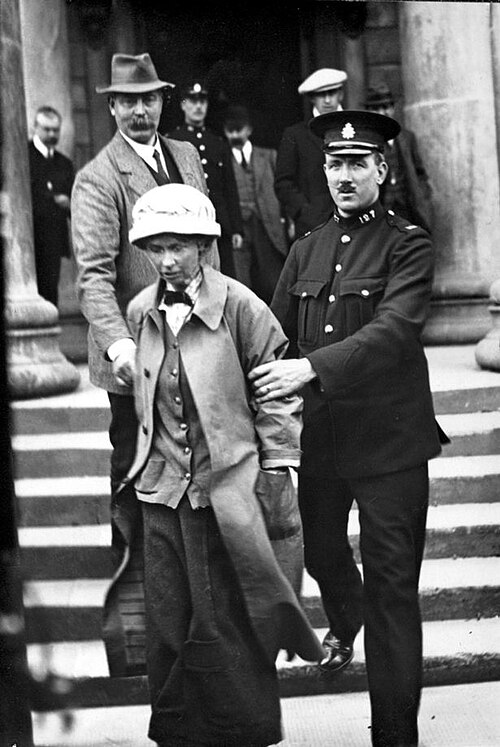
 Frances Mary "Fanny" Parker OBE (December 24, 1875 – January 19, 1924) was a New Zealand-born suffragette who became a prominent, high-profile figure in
the militant wing of the Scottish women's suffrage movement.
Frances Mary "Fanny" Parker OBE (December 24, 1875 – January 19, 1924) was a New Zealand-born suffragette who became a prominent, high-profile figure in
the militant wing of the Scottish women's suffrage movement.Partner Ethel Moorhead
Queer Places:
Waihao Downs Homestead, 20 Serpentine Valley Road, Waihao Downs, RD 7, Waimate 7977, Canterbury, New Zealand
University of Cambridge, 4 Mill Ln, Cambridge CB2 1RZ
61 Nethergate, Dundee DD1 4DH, United Kingdom
(1914) 33 Cambridge Mansions, 13 Bromell's Rd, London SW4 0BN, UK
(1924) 36 George St, Edinburgh EH2 2LE, UK
Hôtel de la Forêt (later Hôtel Régina et d'Angleterre, now Résidence Villa Régina), 11 Allée Corrigan, 33120 Arcachon, Gironde, France
Frances Mary "Fanny" Parker OBE (December 24, 1875 – January 19, 1924) was a New Zealand-born suffragette who became a prominent, high-profile figure in
the militant wing of the Scottish women's suffrage movement.
Born at Waihao Downs Homestead in Waimate District, Canterbury, New Zealand, she was one of five children born to Harry Rainy Parker and Frances Emily Jane Kitchener. Through her maternal family line, Parker was the niece of Field-Marshal Horatio Herbert Kitchener, 1st Earl Kitchener, who funded her higher education abroad.
In 1896, three years after New Zealand granted women the right to vote, Parker traveled to England to study at Newnham College, Cambridge. She completed her degree in 1899 and returned to New Zealand to work as a teacher for several years before relocating permanently to Britain to join the suffrage movement. She initially campaigned as a speaker with the Scottish Universities Women's Suffrage Union before joining Emmeline Pankhurst's Women's Social and Political Union (WSPU), serving as an organizer in the West of Scotland by 1912.
Parker participated in increasingly direct militant action and faced multiple arrests and incarcerations. Following a demonstration in 1908, she served six weeks for obstruction. In March 1912, she was sentenced to four months in Holloway Prison after participating in a WSPU window-smashing campaign in London. During her imprisonment at Holloway, she signed her name alongside fellow activists on "The Suffragette Handkerchief." Later that same year, she was arrested twice more for breaking windows and attempting to disrupt an address by David Lloyd George at the Aberdeen Music Hall. During these imprisonments, Parker went on hunger strikes and was subjected to forced feeding.
By 1914, suffrage tactics intensified. In July 1914, Parker and fellow activist Ethel Moorhead attempted to burn down Burns Cottage in Alloway. Moorhead escaped the scene, but Parker was arrested under the alias Janet Arthur. While held on remand at Perth Prison, Parker engaged in a hunger and thirst strike. Prison authorities subjected her to severe force-feeding methods, including rectal feeding, which resulted in serious physical trauma. Parker smuggled details of her maltreatment out of prison, publishing an account under the name Janet Parker in the Votes for Women newspaper. Due to critical illness caused by her treatment, she was transferred to a nursing home, from which she successfully escaped. For her endurance and actions, the WSPU awarded her the Hunger Strike Medal "for Valour."
Following the outbreak of World War I and the declaration of amnesty for suffragettes, Parker served in the Women's Army Auxiliary Corps (later Queen Mary's Army Auxiliary Corps) and was awarded an Order of the British Empire (OBE). Following the war, Parker relocated to Arcachon, near Bordeaux, France, where she lived until her death on January 19, 1924, at the age of 48. Upon her death, she bequeathed her Hunger Strike Medal to her close friend, campaign partner, and companion Ethel Moorhead. When Frances Parker it is virtually certain that she was living there with Ethel Moorhead and the latter's protégé, Ernest Walsh. By her will, of which Janie Allan was executor, apart from a small bequest to her sister, Frances Parker left all her property to Ethel Moorhead "in grateful remembrance for her care and love". The first issue of This Quarter, a literary magazine edited by Moorhead and Walsh, funded by this bequest, contains a poem and the reproduction of two paintings by Frances Parker, alongside contributions from Gertrude Stein, Bryher, H.D., and Ernest Hemingway.
References:
 The Women's Suffrage Movement (Women's and Gender History) 1st Edition by Elizabeth Crawford |
Other references:
Support this project
This website is a passion project researched, developed, and funded entirely by me. If you find the content valuable and would like to help support the ongoing research and hosting costs, any contribution is deeply appreciated.
Thank you for keeping this independent resource alive!
My books on Amazon: Elisa Rolle's books